Blog
Proprietary blend math: 200 mg split 22 ways
Glyco Harmony's blend is 200 mg per mL, shared by 22 ingredients with no single amounts. The order still sets hard limits. The ingredient in place k can weigh at most 200 divided by k, so gymnema, eighth, tops out near 25 mg, and ginseng, twelfth, near 16.7 mg. Studies of those plants used far more.
Written by the Glyco Harmony research deskUpdated · 8 min read
01The rule
What is a proprietary blend on a supplement label?
It is a group of ingredients printed with one total weight instead of one weight each. US labeling rules allow it, as long as the ingredients appear from most to least by weight (21 CFR 101.36 (eCFR)).
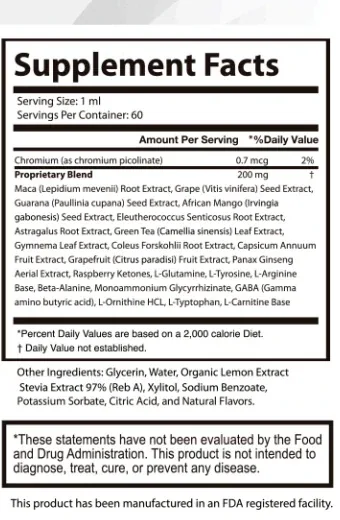
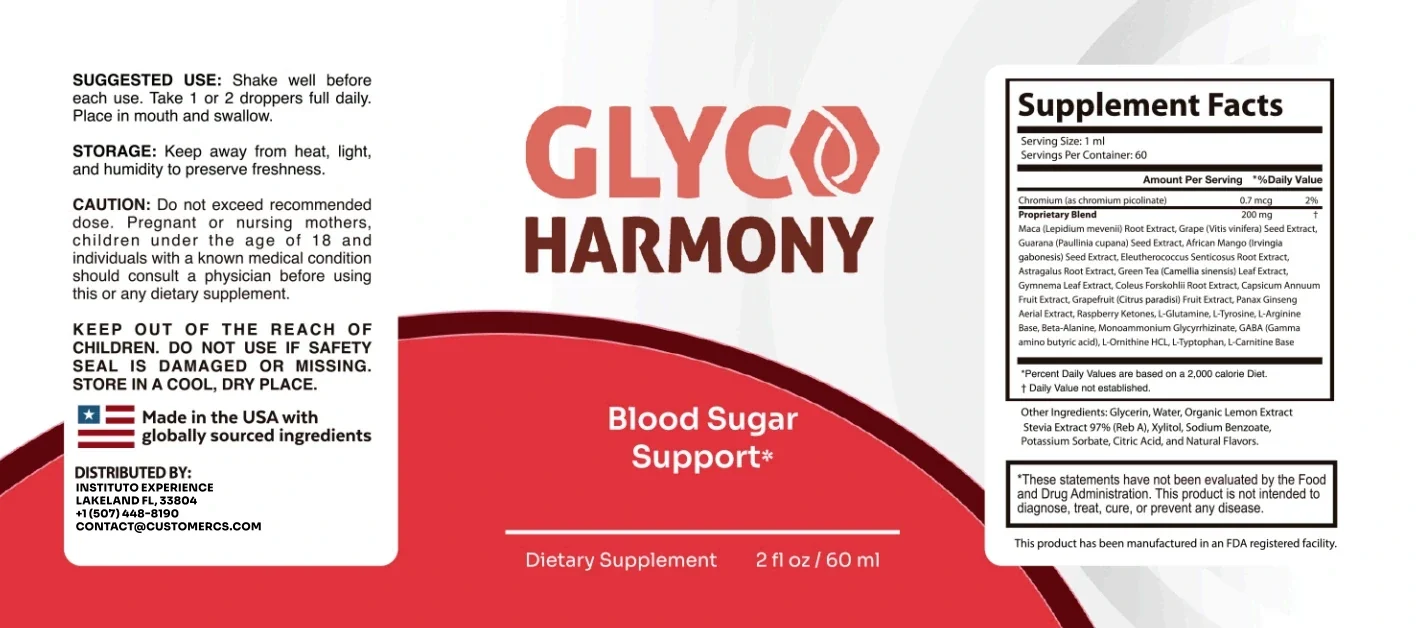
Glyco Harmony uses one. Each 1 mL lists "Proprietary Blend 200 mg", followed by 22 names. Maca root comes first and L-carnitine base comes last. Only chromium, at 0.7 mcg, sits outside the blend with its own amount.
02The average
What is the average share of each Glyco Harmony blend ingredient?
About 9.1 mg per mL. That is 200 mg divided by 22. At two droppers a day, the average share doubles to about 18.2 mg.
The average is a starting point, not a real amount. No ingredient has to sit at 9.1 mg. Maca could be far heavier, and the amino acids at the end could be much lighter.
03The ceiling
How much can each line of the blend weigh at most?
The line in place k can weigh at most the total divided by k. For Glyco Harmony that is 200 mg divided by the line's place on the label.
The logic is simple. Take gymnema, in eighth place. The seven lines above it must each weigh at least as much as gymnema. So the first eight lines together weigh at least eight times gymnema. They all fit inside 200 mg, so gymnema can be no more than 200 / 8 = 25 mg.
| Place | Ingredient | Max in 1 mL | Max in 2 mL |
|---|---|---|---|
| 1 | Maca root | Under 200 | Under 400 |
| 2 | Grape seed | 100 | 200 |
| 3 | Guarana seed | 66.7 | 133.3 |
| 4 | African mango seed | 50 | 100 |
| 5 | Eleuthero root | 40 | 80 |
| 6 | Astragalus root | 33.3 | 66.7 |
| 7 | Green tea leaf | 28.6 | 57.1 |
| 8 | Gymnema leaf | 25 | 50 |
| 9 | Coleus forskohlii root | 22.2 | 44.4 |
| 10 | Capsicum annuum fruit | 20 | 40 |
| 11 | Grapefruit fruit | 18.2 | 36.4 |
| 12 | Panax ginseng aerial | 16.7 | 33.3 |
| 13 | Raspberry ketones | 15.4 | 30.8 |
| 14 | L-glutamine | 14.3 | 28.6 |
| 15 | L-tyrosine | 13.3 | 26.7 |
| 16 | L-arginine base | 12.5 | 25 |
| 17 | Beta-alanine | 11.8 | 23.5 |
| 18 | Monoammonium glycyrrhizinate | 11.1 | 22.2 |
| 19 | GABA | 10.5 | 21.1 |
| 20 | L-ornithine HCL | 10 | 20 |
| 21 | L-tryptophan | 9.5 | 19 |
| 22 | L-carnitine base | 9.1 | 18.2 |
Every ceiling assumes the lines above it are equal and the lines below it weigh almost nothing. Real amounts sit below these numbers, and probably well below for most lines.
04The floor
Does the order guarantee a minimum for any ingredient?
Only for the first one. Maca, as the heaviest line, must weigh at least the average, about 9.1 mg per mL. Otherwise all 22 lines could not add up to 200 mg.
- Maca sits somewhere between about 9.1 mg and just under 200 mg per mL.
- Lines 2 to 21 have a ceiling but no floor. Any of them could be a trace.
- L-carnitine, in last place, can weigh no more than the average, about 9.1 mg.
- The ceilings cannot all be reached at once. If gymnema really weighed 25 mg, the first eight lines would fill the whole 200 mg and leave nothing for the other 14.
05Dose check
How do the blend ceilings compare with studied doses?
Even the best case falls short for the best-known ingredients. The table uses the ceiling at two droppers, the most the label allows in a day.
| Ingredient (place) | Ceiling at 2 mL | Studied daily amount |
|---|---|---|
| African mango (4) | 100 mg | 300 mg in a small trial (NIH ODS, Dietary Supplements for Weight Loss) |
| Gymnema (8) | 50 mg | 200-400 mg standardized extract (Drugs.com, Gymnema monograph) |
| Coleus forskohlii (9) | 44.4 mg | 500 mg of extract (NIH ODS, Dietary Supplements for Weight Loss) |
| Panax ginseng (12) | 33.3 mg | About 100 mg to 20 g, mostly root (Shishtar et al., PLoS One 2014) |
| L-carnitine (22) | 18.2 mg | 2-3 g (NIH ODS, Carnitine) |
Gymnema showed a small fasting-glucose drop, and ginseng about 5.6 mg/dL with no change in A1C (Drugs.com, Gymnema monograph) (Shishtar et al., PLoS One 2014). NCCIH finds no reliable evidence that any herbal supplement controls diabetes (NCCIH, Diabetes and Dietary Supplements). More on each plant is on the ingredients page.
Glyco Harmony: from $36 a bottle60 mL drops · 2, 4 or 8 bottles · free US shipping on 4 and 8 · 60-day money-back
See packs06Why blends
Why do supplement makers hide single amounts?
Because the rules let them, and because a blend protects a formula from copycats. That is a fair business reason. It also makes a label hard to judge.
A shopper cannot hold a hidden amount up against a study. The FTC says health claims need good human trials of the same product, dose and population (FTC, Health Products Compliance Guidance). Without amounts, nobody outside the maker can even say which dose is in the bottle.
The blend also hides caffeine. Guarana sits third, so it could be up to 66.7 mg of extract per mL, but the caffeine inside that extract is not printed (MSKCC, Guarana). Green tea adds some more.
07Poster vs label
What do the brand poster and the label each show about the blend?
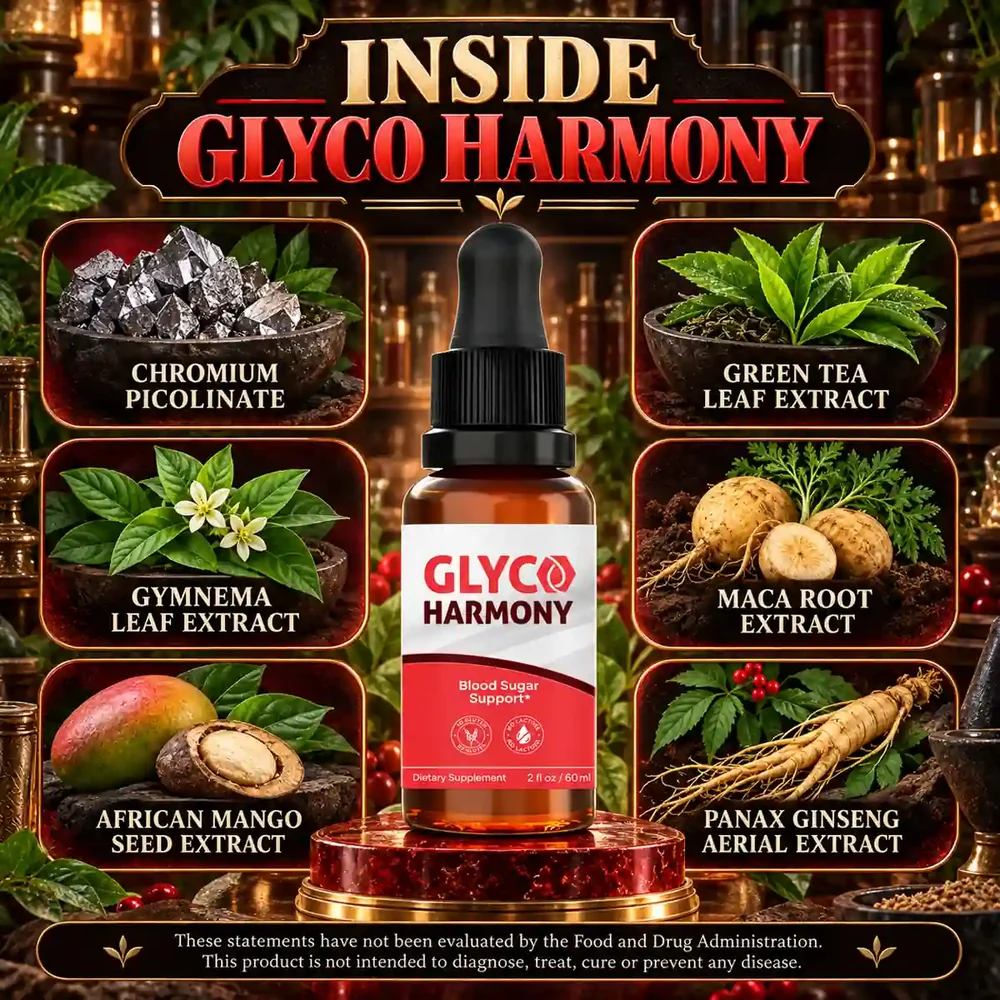
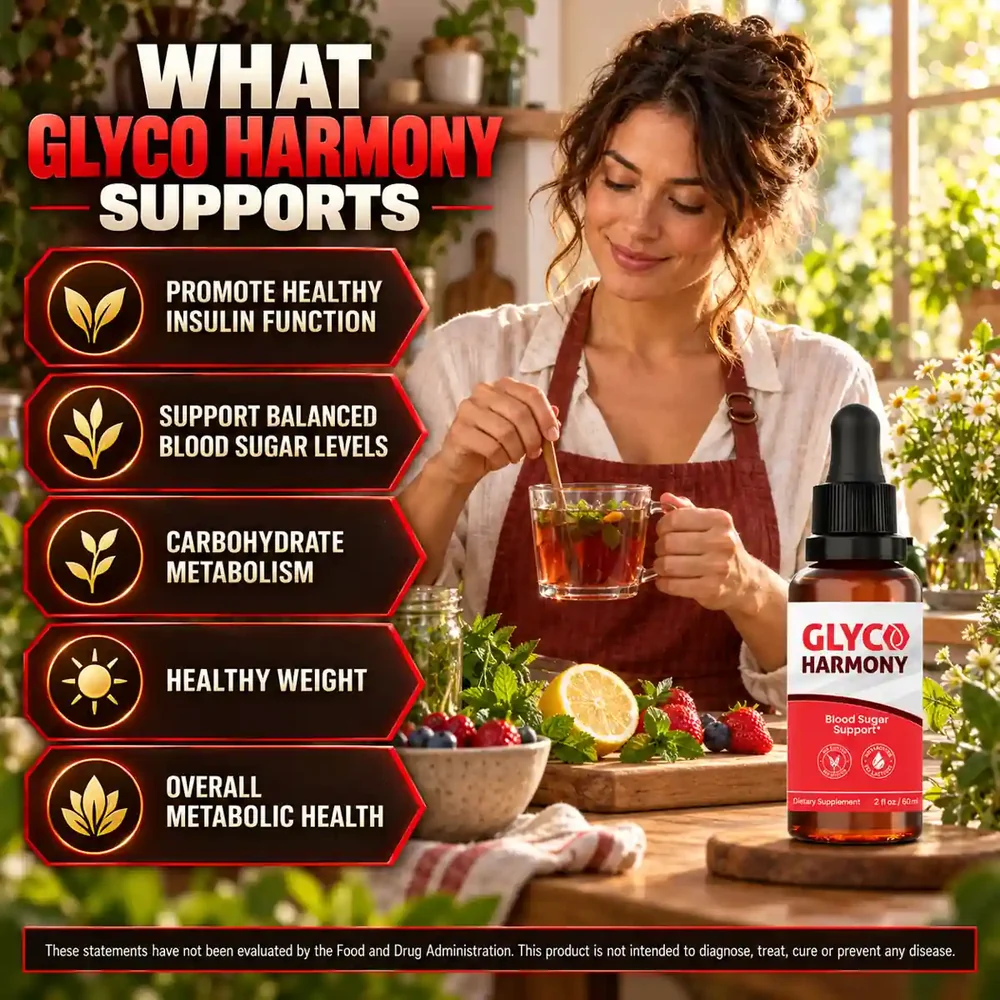
The poster shows six ingredients and no numbers. The label shows all 22 blend lines and one total. Chromium, green tea, gymnema, maca, African mango and Panax ginseng get the poster's tiles.
Several of the poster's stars sit low in the weight order. Gymnema is eighth and ginseng is twelfth. The poster also draws a ginseng root, while the label lists an aerial extract made from leaf and stem. The panel uses three odd spellings too, covered on the label explained.
08Your turn
How can you use blend math when you shop?
Four quick steps work on any label with a blend.
Find the total and count the lines
Divide the total by the count to get the average share.
Find the ingredient you care about
Note its place. Divide the total by that place to get its ceiling.
Look up a studied dose
Use a public source such as an NIH fact sheet. Compare the daily amount, not a single serving.
Ask before you add it
Show the label to your doctor or pharmacist, especially if you take diabetes, blood pressure or blood-thinning medicine.
Keep taking prescribed medicine; never stop or change it because of a supplement. Some blend ingredients may add to diabetes drugs, and the ADA advises talking with your care team first (ADA, Vitamins & Supplements). See how each ad claim holds up on claims vs evidence.
09FAQ
Proprietary blend math: FAQ
How much maca is in Glyco Harmony?
The exact amount is not disclosed. Because maca is the first and heaviest blend line, each 1 mL holds at least about 9.1 mg and somewhat under 200 mg. Maca has a few small human trials, none on blood sugar (MSKCC, Maca).
Why is maca listed first in the Glyco Harmony blend?
Blend ingredients must appear from most to least by weight (21 CFR 101.36 (eCFR)), so maca is first because it weighs the most. The rule says nothing about strength, quality or effect, only weight inside the 200 mg.
Is a proprietary blend legal on a supplement label?
Yes. Federal labeling rules let a supplement print a blend with its total weight and its ingredients in descending order by weight, without each one's amount (21 CFR 101.36 (eCFR)). Legal does not mean easy to judge.
How much gymnema could one dropper of Glyco Harmony contain?
At most about 25 mg, and almost surely less. Gymnema is eighth of 22 lines in a 200 mg blend. Studies used 200-400 mg a day of a standardized extract (Drugs.com, Gymnema monograph), so even two droppers stay below that range.
Can you work out the exact amounts in a proprietary blend?
No. The total and the order give an average, a ceiling for each line and a floor for the first one. They cannot reveal the real split. Only the maker has those numbers, and none are published for Glyco Harmony.
Does a longer ingredient list make a supplement stronger?
Not on its own. With a fixed total, each added ingredient shrinks the average share. Glyco Harmony splits 200 mg across 22 lines, about 9.1 mg each, while single-ingredient studies often used hundreds of milligrams or grams.
Can I ask for the amounts in the Glyco Harmony blend?
You can ask the label's distributor, INSTITUTO EXPERIENCE, Lakeland FL 33804, at +1 (507) 448-8190. We have no breakdown on file and do not publish guesses. The label itself only gives the 200 mg total and the order.
10Who wrote this
Written and reviewed by
Pages built from the label, the official sales page and linked NIH, CDC, FDA, FTC and peer-reviewed sources.
Last updated . Read our editorial policy and how we check reviews. This website is run by a U.S. stocking partner, not by the manufacturer or the label's distributor. We earn money when you buy through our order links.
Keep reading
More about Glyco Harmony
U.S. stocking partner for Glyco Harmony
Ready to try Glyco Harmony?
Check your medicines first, then pick a pack. Bigger packs cost less per bottle, 4 and 8 bottles ship free in the US, and the guarantee runs 60 days from purchase.
- Official checkout (ClickBank)
- 60-day money-back
- Free US shipping on 4 and 8 bottles